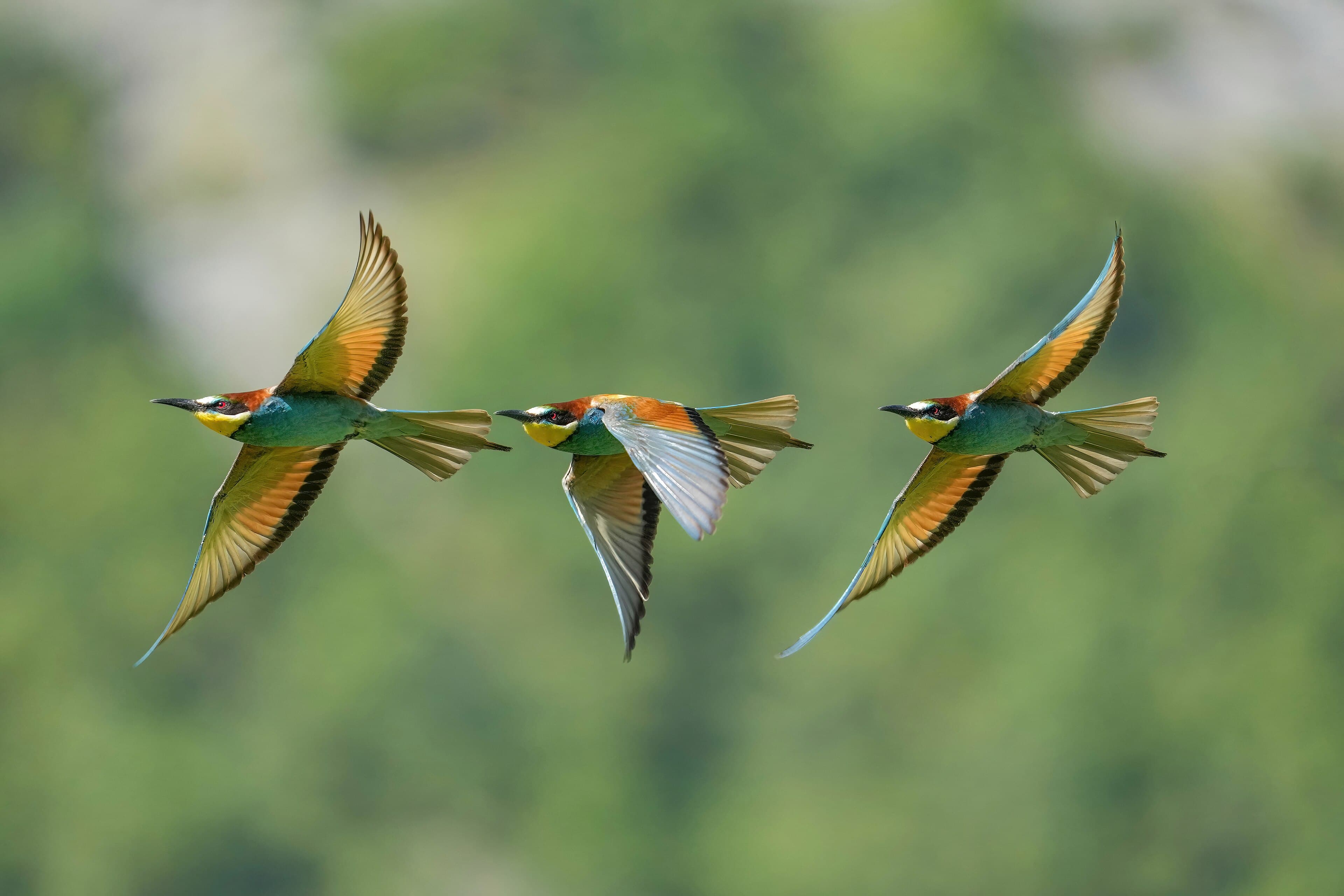
Photographed at Pfyn-Finges, SwitzerlandThree frames stacked
Camera data: Sony α1600 mmf/6.31/2000 sISO 1000Pfyn-Finges, Switzerland
Behind the shot: three bee-eaters that are one bird
Giles Laurent's stacked sequence of a European bee-eater shows the whole arc of a wingbeat in a single frame. Here is what a stacked image is, how this one was built, and why saying so matters.
By WLIFE EditorialPhotographs Giles Laurent6 min read
At first glance this looks like three European bee-eaters flying in close formation. It is one bird, photographed three times in quick succession and combined into a single frame. The photographer, Giles Laurent, says exactly that in the first line of the file description, and the image's title on Wikimedia Commons begins with the words "Stacked images". That transparency is the reason we chose it for this column. The photograph is beautiful; the disclosure is the lesson.
What the file says
“Image created by stacking three photographs of an European bee-eater (Merops apiaster) in flight at Pfyn-Finges, Switzerland.”
Giles Laurent, file description on Wikimedia Commons
| Field | Value (from Commons EXIF) |
|---|---|
| Camera | Sony ILCE-1 |
| Lens | FE 200–600 mm F5.6–6.3 G OSS |
| Focal length | 600 mm |
| Exposure | 1/2000 s at f/6.3 |
| ISO | 1000 |
| Date and time | 10 July 2022, 16:40 |
| Software | Adobe Photoshop Lightroom Classic 9.3 |
The Commons community has assessed the file as a Featured Picture, a Quality Image and the most valued image in its scope, which the page describes as chronophotography of the species in flight. It was Picture of the Day on 2 June 2025 and was entered in the Wiki Science Competition 2023. The word chronophotography is the key to understanding what the image is.
What a stacked image is
Chronophotography is a technique almost as old as photography itself: recording successive phases of a movement and presenting them together, so that time is laid out across space. In the film era it required multiple exposures on one plate. Today it is usually done by shooting a burst of frames from a fixed position and then layering them in editing software, keeping the moving subject from each frame and a single static background. The result is often called a stacked image, a sequence composite or a multiplicity image.
The settings in the table are consistent with that method. A shutter speed of 1/2000 s freezes each wingbeat. A high frame rate, which the camera listed is capable of, provides frames spaced closely enough that the three positions of the bird read as one continuous movement. The high ISO of 1000 in afternoon light is the price of that shutter speed with an f/6.3 lens. The camera must not move between frames, or the backgrounds will not align; a bird crossing a clean sky, as here, makes alignment far easier than a bird crossing foliage.
- Shoot a burst from a fixed position with a fast shutter, tracking the bird only with focus, not with the camera.
- Select frames spaced evenly enough that the positions do not overlap and the wing phases tell a story.
- Layer the frames in software and mask each copy of the bird onto a single background.
- Check that light, colour and sharpness match across all copies, which they will if the frames came from one burst.
- Label the result as a composite wherever it is published.
Why the disclosure matters
A stacked sequence is not a fake. Each bird in the frame is a real exposure of a real bird at a real moment. But the combined image shows something that never existed as a single scene, and a viewer who did not know that would reasonably believe they were looking at three birds. That is the line that wildlife photography's major institutions draw. Documentary competitions generally require that an image is a single capture, or that any multiple-image work is entered in a category that allows it and is declared. Editorial publications ask for composites to be captioned as such. The principle in every case is the same: the viewer must be able to tell what kind of truth they are looking at.
Laurent's handling is a model. The composite is declared in the file title, repeated in the first sentence of the description and reflected in the scope under which the Commons community assessed it. Nobody encountering this file can mistake it for a flock. The ethics of composite imagery are not about whether you may combine frames, but about whether you tell people you did, and this is what telling people looks like.
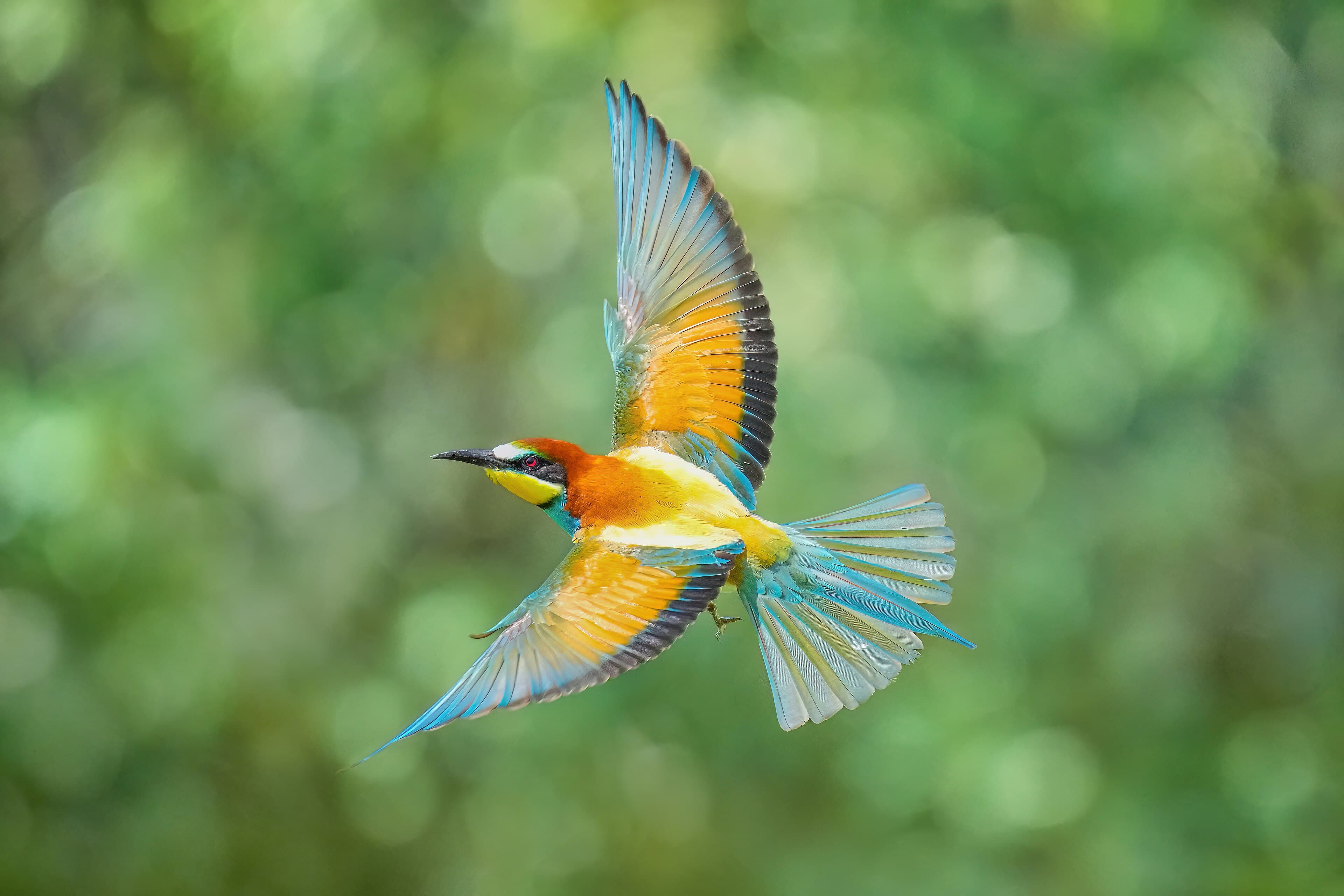
An editor's reading
Our own view of why the frame works, offered as interpretation: the three positions are spaced so that the wings read as open, mid-stroke and closed, which is the full cycle of a beat. The bird travels across the frame from one side to the other, in the direction a reader's eye naturally moves, so the sequence is read in the right order without effort. And the background is a plain tone with nothing in it, which is what makes the illusion of simultaneity so complete. Removing everything that is not the bird is the composite's quiet discipline, and it is the same discipline that makes single-frame bird photography succeed.
Sources
About the author
WLIFE Editorial
The WLIFE editorial desk researches, writes and fact-checks stories about wildlife photography, photographers, equipment and expeditions.
Credits
- Words
- WLIFE Editorial
- Photographer
- Giles Laurent
- Photograph
- Giles Laurent · Pfyn-Finges, Switzerland · Three frames stacked · CC BY-SA 4.0
- Photograph
- Giles Laurent · Pfyn-Finges, Switzerland · CC BY-SA 4.0
- Fact-check
- In progress
Fact-check notes · Sample article — verify all facts before editorial publication. Description, EXIF (Sony ILCE-1, FE 200-600, 600 mm, 1/2000 s, f/6.3, ISO 1000, 10 July 2022, Lightroom Classic 9.3), awards (FP, QI, VI scope 'chronophotography', POTD 2 June 2025, Wiki Science Competition 2023) read from the Commons file page on 2026-10-23. The single-exposure bee-eater (019, Pfyn-Finges, FP and QI) was read from its Commons file page on 2026-11-03. The step-by-step method is a general description of the technique, not a statement of the photographer's actual workflow.
Read next
Behind the Shot
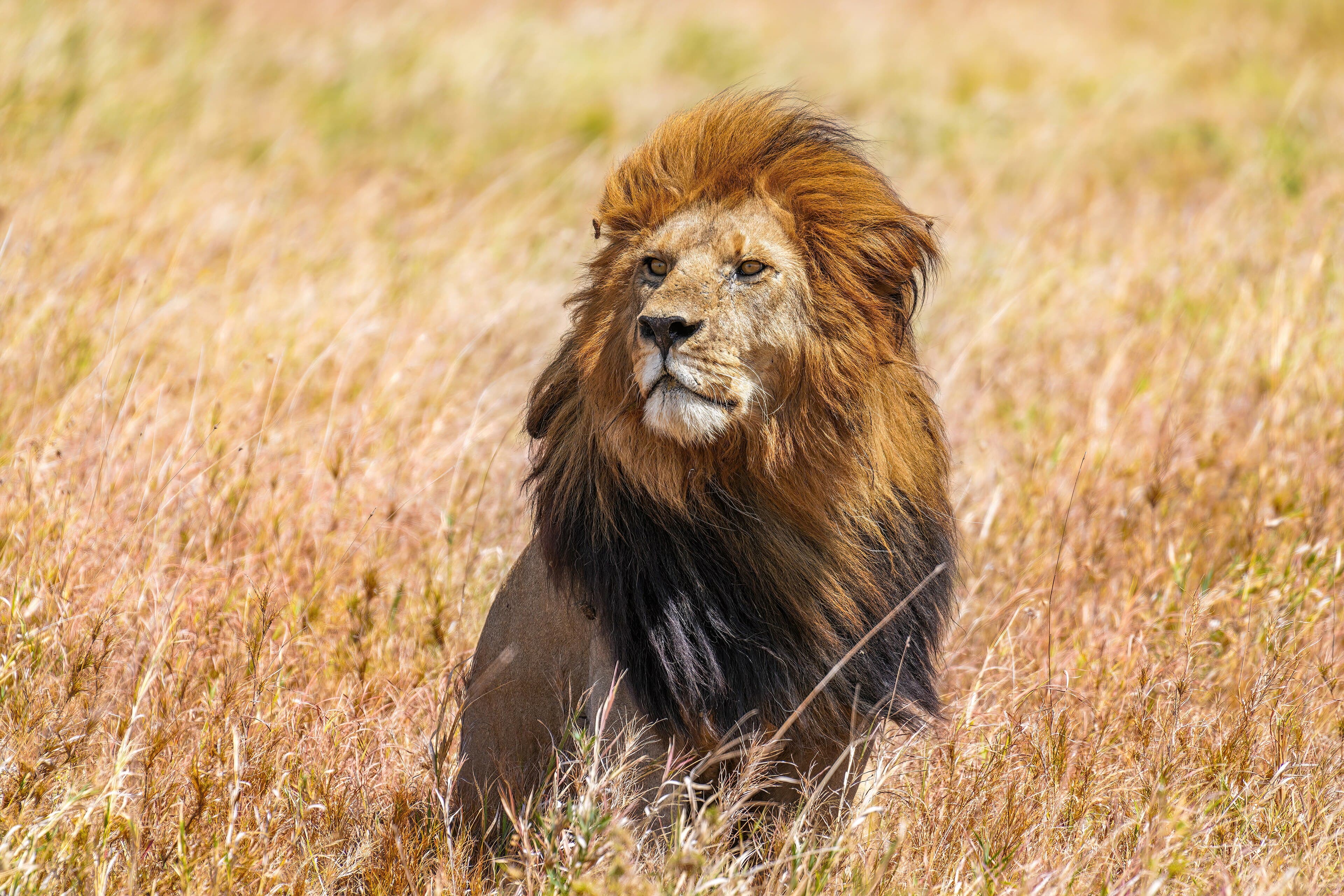
Sample contentBehind the shot: Snyggve, the Serengeti lion who looked back
A direct gaze, soft light and a background that disappears: what the file data and the frame itself tell us about one of the most-viewed lion portraits on Wikimedia Commons.
· 6 min
Fieldcraft & Technique
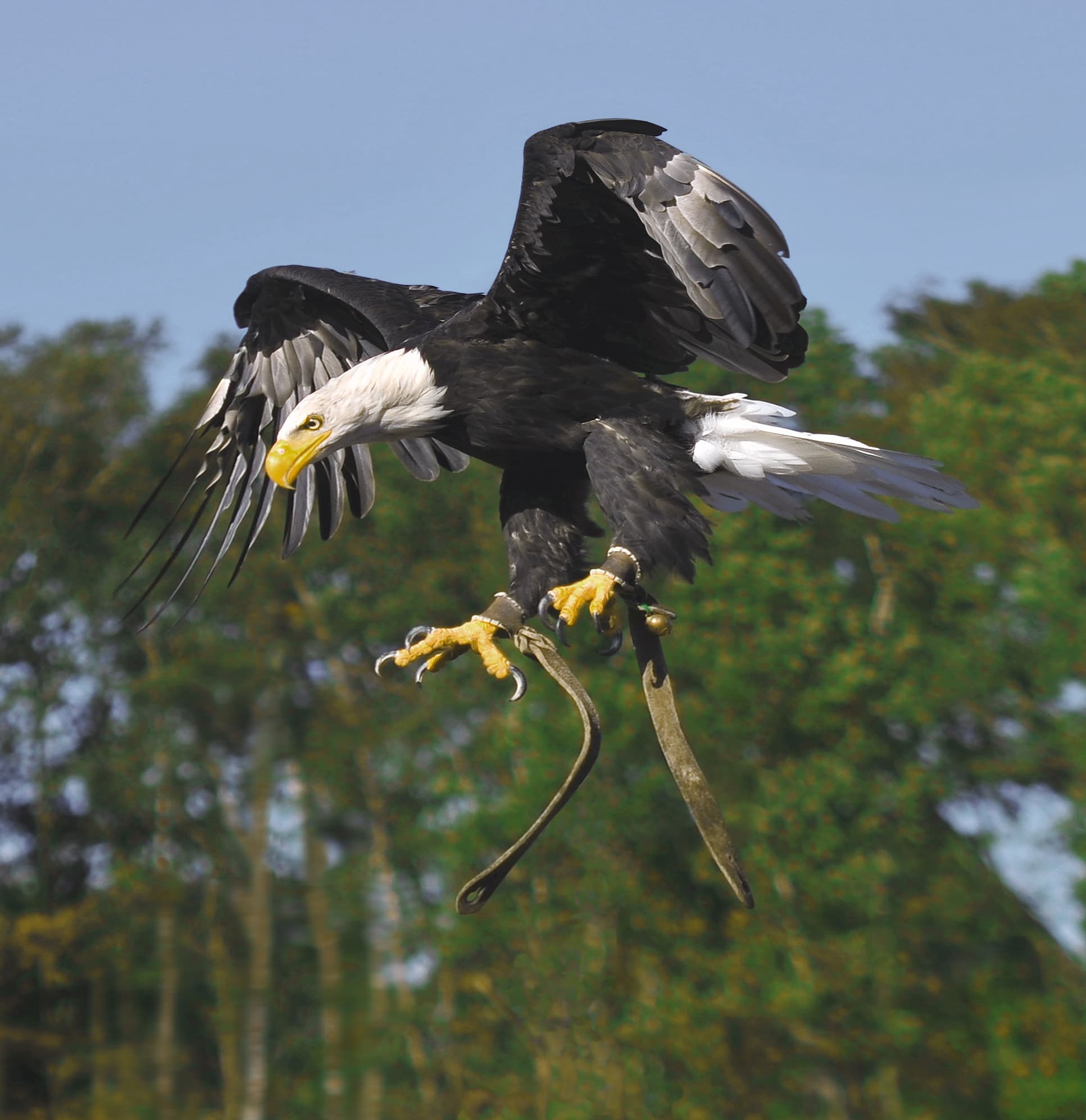
Sample contentHow to photograph birds in flight
Flight photography is the hardest discipline in wildlife work and the most learnable. Approach, light, tracking, backgrounds and ethics, in the order that matters.
· 8 min
News
Sample contentWildlife Photographer of the Year: how the competition works and what the winning images teach
The Natural History Museum's annual competition is the closest thing wildlife photography has to a world championship. Here is how it is judged, what it rewards and what every entrant can learn from it.
· 6 min
The WLIFE Dispatch · weekly
The week’s best wildlife photography, in one email.
New images, photographer stories, gear tested in the field and expedition openings. Free, unsubscribe any time.