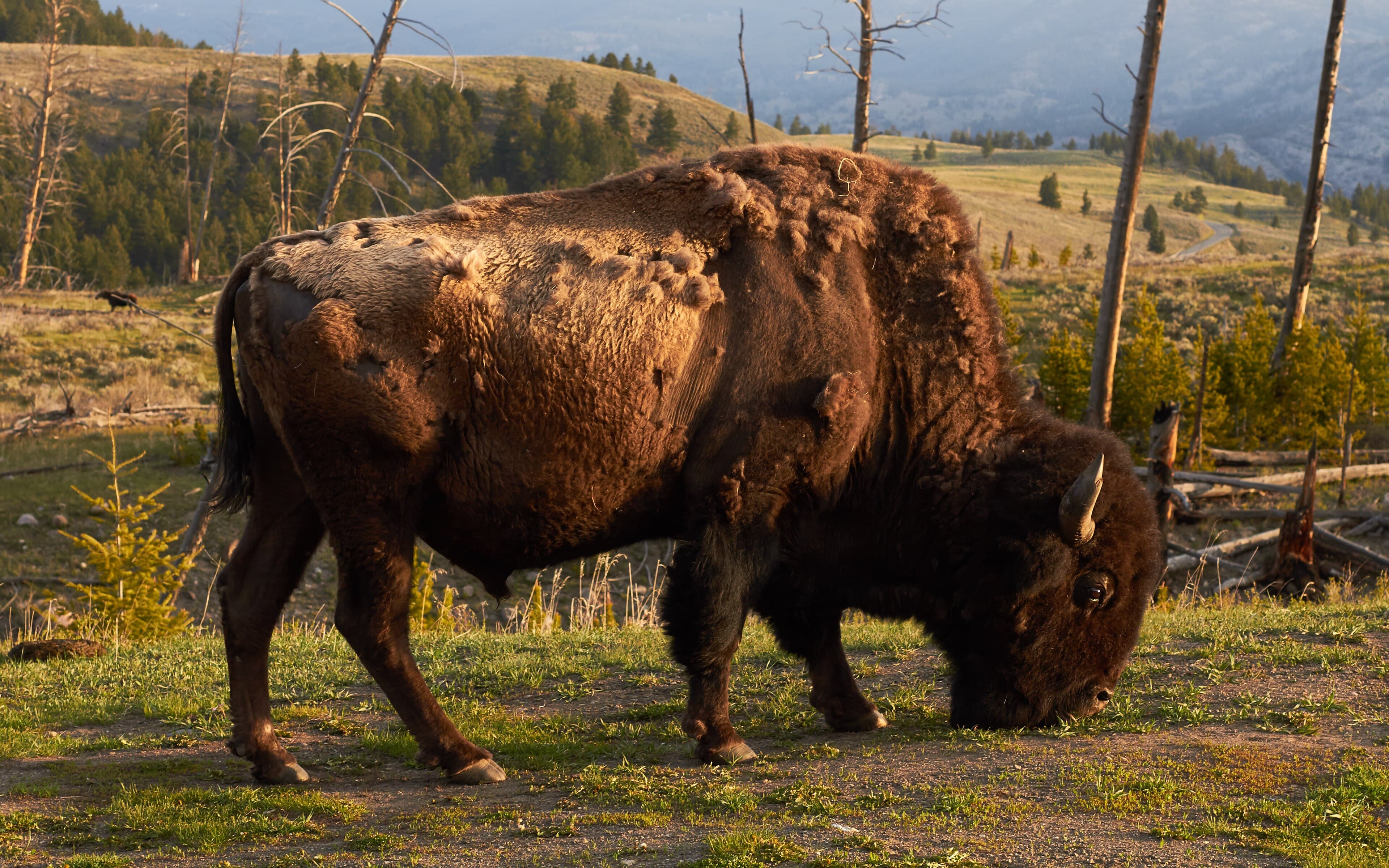
Photographed at Yellowstone National Park, USA
Camera data: Canon EOS 7D50 mmf/7.11/80 sISO 100Yellowstone National Park, USA
United States · Moderate
Sample contentYellowstone National Park
Yellowstone is North America's great wildlife theatre: bison, elk, wolves and bears across wide valleys and geothermal basins, at its most photogenic in deep winter snow and steam.
- Best season
- January–February · Late April–May · Late September–October
- Difficulty
- Moderate (2/5)
- Key species
- American bison, Grey wolf, Elk, Grizzly bear
- Budget
- USD 200–600 per person per day (estimate)
United States
The place
Yellowstone National Park, established in 1872 as the world's first national park, covers close to 9,000 square kilometres across the corners of Wyoming, Montana and Idaho on a high volcanic plateau. Most of the park sits above 2,000 metres. Its geothermal features — geysers, hot springs and steaming rivers — are world famous, but for wildlife photographers the draw is the open northern range, where the Lamar and Hayden valleys hold North America's most visible populations of large mammals.
Bison are the park's signature animal and are found in large herds in the Lamar and Hayden valleys and along the Madison River. Elk, pronghorn, bighorn sheep, mule deer and moose share the ranges, and both grizzly and black bears are seen in spring and autumn. Grey wolves, reintroduced to the park in 1995, are watched most reliably in the Lamar Valley, usually at long range with spotting scopes; photographs of wolves at a usable distance are rare and take patience over many days. Coyotes, red foxes and river otters are frequent subjects in winter.
Visitors drive their own vehicles or join guided tours on the road network, stopping at pull-outs; animals are photographed from the roadside, with park regulations requiring visitors to stay at least 25 yards (about 23 metres) from bison, elk and other large animals and 100 yards (about 91 metres) from bears and wolves. In winter most park roads close to cars and reopen only to guided snowcoaches and snowmobiles, usually from mid-December to mid-March, while the northern road from the North Entrance at Gardiner through Mammoth and the Lamar Valley to Cooke City stays open to ordinary vehicles all year.
Winter is the photographer's season: bison crusted in frost and steam, coyotes hunting in snow, foxes mousing, and the stark graphic quality of white valleys. Temperatures can fall far below freezing, which tests batteries, fingers and lens fogging. Spring brings bison calves and bears emerging from dens, and late September and October the elk rut, with bugling bulls in the Mammoth and Madison areas.
Species and photographic opportunities
The animals
- American bison
- Large herds in the Lamar and Hayden valleys; winter frost and steam images
- Grey wolf
- Lamar Valley packs, mostly at long range
- Elk
- Rut in late September and October around Mammoth and the Madison River
- Grizzly bear
- Spring and autumn in the valleys and meadows; 100-yard minimum distance
- Black bear
- Tower–Roosevelt area in spring
- Coyote
- Hunting voles in snow; the most photogenic winter predator
- Red fox
- Winter mousing on the northern range
- Pronghorn
- Lamar Valley and the northern range
- Bighorn sheep
- Cliffs near the Gardner River and Lamar Canyon
- Trumpeter swan and bald eagle
- Open rivers in winter
- Bison in snow and geothermal steam in winter
- Coyotes and red foxes hunting in snow on the northern range
- Wolves in the Lamar Valley at distance, with scope-assisted spotting
- Elk rut in autumn at Mammoth and along the Madison
- Grizzly and black bears with cubs in spring
- Bald eagles and trumpeter swans on ice-free river stretches
When to go
The season
| Months | Why |
|---|---|
| January–February | Deep winter: snow, frost and steam; most roads closed to cars, so access is via the northern road or guided snowcoach. |
| Late April–May | Bears emerge, bison calves appear and many roads reopen; weather is changeable. |
| Late September–October | Elk rut, autumn colour and bears feeding before winter; fewer visitors than summer. |
Light, access and conditions
The ground
- Winter temperatures far below freezing; battery life, lens fogging and frostbite risk all need managing
- Most interior roads closed to private vehicles from early November until spring; winter interior access only by snowcoach or snowmobile
- Legal minimum distances: 25 yards from bison and other large animals, 100 yards from bears and wolves
- High altitude above 2,000 m; roads can close at short notice in storms
- Wildlife is photographed from the roadside; walking off-road near animals is both dangerous and restricted
- Bear spray is recommended for any walking outside developed areas in bear season
Trip difficulty: Moderate. Access is easy by road, but winter cold and the long, patient hours needed for wolves and foxes raise the practical difficulty.
Editorial estimate
The cost
USD 200–600 per person per day (USD)
Basis: Self-drive with lodging in or near the park, rising to guided winter snowcoach photography tours; excludes flights and park entrance fee
Editorial estimate only, not a quote. Ranges are broad and exclude international flights. Verify current rates, park fees and seasonal surcharges with operators before planning. Last reviewed 2026-10-20.
Questions
Can I photograph wolves in Yellowstone?
Wolves are seen fairly reliably in the Lamar Valley, but mostly at distances better suited to a spotting scope. Frame-filling images are uncommon and reward multiple winter days with a guide who follows the packs' movements.
Which roads are open in winter?
Only the northern road between Gardiner, Mammoth, the Lamar Valley and Cooke City stays open to normal vehicles. Interior roads are reserved for guided snowcoaches and snowmobiles, typically from mid-December to mid-March.
Is a tripod useful?
Yes, more than in most wildlife destinations. Roadside work from pull-outs allows a tripod and gimbal, which helps with long waits and heavy lenses in the cold.
Credits
- Photograph
- Frank Schulenburg · Yellowstone National Park, USA · CC BY-SA 4.0