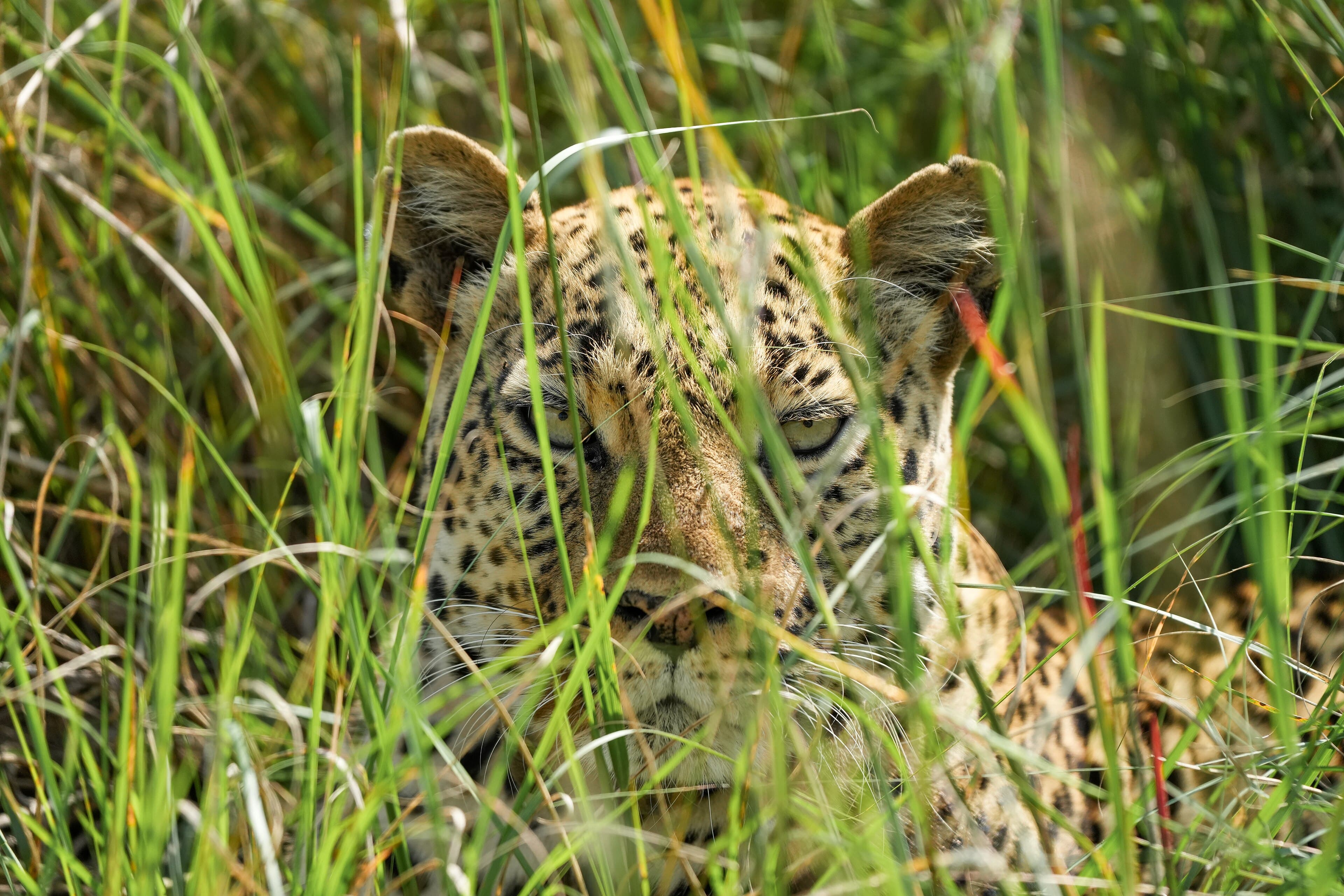
Photographed at Queen Elizabeth National Park, Uganda
Camera data: Sony α1478 mmf/6.31/1250 sISO 640Queen Elizabeth National Park, Uganda
Uganda · Moderate
Sample contentQueen Elizabeth National Park
Queen Elizabeth National Park combines savanna lions, the hippo-packed Kazinga Channel, crater lakes and the tree-climbing lions of Ishasha in a single Albertine Rift landscape.
- Best season
- June–August · December–February · March–May and September–November
- Difficulty
- Moderate (2/5)
- Key species
- Lion, African elephant, Hippopotamus, Uganda kob
- Budget
- USD 250–700 per person per day (estimate)
Uganda
The place
Queen Elizabeth National Park lies in western Uganda on the floor of the Albertine Rift, between Lake Edward and Lake George, with the Rwenzori Mountains rising to the north and the Democratic Republic of the Congo's Virunga National Park across the border to the west. The park covers roughly 2,000 square kilometres of savanna, acacia woodland, wetland, forest and volcanic crater lakes, and is Uganda's most visited savanna park. Its bird list, commonly cited at more than 600 species, is one of the longest of any protected area in Africa.
The park divides into two main sectors. In the north, around the Mweya peninsula and the Kasenyi plains, game drives find lions, elephants, buffalo and large herds of Uganda kob, whose breeding grounds are a focus for predators. The Kazinga Channel, a natural waterway of about 32 kilometres linking the two lakes, carries one of Africa's densest concentrations of hippos, with elephants, buffalo and crocodiles along its banks and huge numbers of waterbirds; two-hour boat cruises operate from Mweya. Kyambura Gorge, a forested ravine on the eastern edge, holds a community of chimpanzees that can be tracked on foot with a ranger.
The southern Ishasha sector, some two hours' drive away, is famous for lions that habitually rest in the branches of fig trees during the heat of the day. Sightings are not guaranteed, but the open savanna and scattered trees make for distinctive photographs. Many itineraries combine Queen Elizabeth with gorilla trekking in Bwindi Impenetrable National Park, which lies to the south of Ishasha.
Photographically the park offers variety rather than the sheer predator density of the Serengeti: lions and elephants on open plains at dawn, hippos and birds from the water in the afternoon, chimpanzees in forest shade, and the lions of Ishasha framed by branches. The equatorial light is strong by mid-morning, so early starts matter, and the channel cruise is one of the few places where a boat gives a stable, low angle on large mammals.
Species and photographic opportunities
The animals
- Lion
- Kasenyi plains; tree-climbing behaviour in the Ishasha sector
- African elephant
- Common along the Kazinga Channel and in the north
- Hippopotamus
- Very high densities in the Kazinga Channel
- Uganda kob
- Breeding grounds on the Kasenyi plains attract predators
- Leopard
- Present but elusive; best around Mweya and Ishasha
- Chimpanzee
- Kyambura Gorge, tracked on foot
- African buffalo
- Large herds, often at the channel
- Nile crocodile
- Banks of the Kazinga Channel
- African skimmer, pelicans and other waterbirds
- Channel margins in large numbers
- Topi
- Ishasha sector grassland
- Lions and kob on the Kasenyi plains in first light
- Hippos, elephants and buffalo from the Kazinga Channel boat at water level
- Tree-climbing lions in fig trees at Ishasha
- Waterbird concentrations on the channel banks in the afternoon
- Chimpanzees in the forest of Kyambura Gorge
- Crater lakes and Rwenzori backdrops for landscape frames
When to go
The season
| Months | Why |
|---|---|
| June–August | Drier months with shorter grass and animals near water; the most popular period. |
| December–February | The second dry season, with good visibility and warm, clear mornings. |
| March–May and September–November | Wetter months with lush scenery and strong birding; some tracks become difficult after heavy rain. |
Light, access and conditions
The ground
- Equatorial climate: hot by mid-morning with rain possible in any month, heaviest in the two wet seasons
- Long road transfers between sectors and from Entebbe or Kampala
- Tsetse flies in some wooded areas; mosquitoes and malaria risk
- Tree-climbing lion sightings at Ishasha are not guaranteed
- Chimpanzee tracking in Kyambura involves steep, humid forest walking
- Game drives are on tracks only; a bean bag on the window ledge is the usual support
Trip difficulty: Moderate. Mostly vehicle- and boat-based and physically easy; the Kyambura chimpanzee walk adds a moderately strenuous forest hike.
Editorial estimate
The cost
USD 250–700 per person per day (USD)
Basis: Mid-range lodge, private 4x4 with driver-guide, park fees and a channel cruise; excludes international flights and gorilla permits elsewhere
Editorial estimate only, not a quote. Ranges are broad and exclude international flights. Verify current rates, park fees and seasonal surcharges with operators before planning. Last reviewed 2026-10-20.
Questions
Why do the Ishasha lions climb trees?
The behaviour is not fully explained; escaping heat and biting insects on the ground and gaining a vantage point over the plains are the usual suggestions. It is a habit of particular prides rather than a separate type of lion.
Is the Kazinga Channel cruise worth it for photographers?
Yes. The boat gives a stable, low angle on hippos, elephants and buffalo at the water's edge and on dense waterbird gatherings, in afternoon light that falls on the banks.
How does it combine with gorilla trekking?
Bwindi Impenetrable National Park lies south of the Ishasha sector, so many itineraries run Queen Elizabeth first and continue to Bwindi for gorillas.
Credits
- Photograph
- Giles Laurent · Queen Elizabeth National Park, Uganda · CC BY-SA 4.0